Korean Traditional Clothing
The Foundations of Korean Dress
Korean traditional clothing, known broadly as hanbok, is the historic dress system of the Korean Peninsula. Worn for over a millennium in everyday life, labor, and ceremony, it is built around a distinct two-piece structure featuring curved yet flat-cut silhouettes and wrap-and-tie fastenings rather than buttons or zippers. For a first-time viewer, it is helpful to see hanbok not merely as a single static costume, but as a comprehensive system of interrelated garments, textiles, colors, and accessories that signal the wearer's identity and respond to the local climate.
The roots of this clothing system trace back to the Three Kingdoms period (57 BCE–668 CE), with ancient murals depicting people wearing early wrap-front jackets alongside loose, spacious trousers and skirts. However, the recognizable bell-shaped silhouette most associated with hanbok today largely reflects the styles of the late Joseon dynasty (1392–1910). During this era, a strict Neo-Confucian social order codified dress regulations, dictating specific fabrics, colors, and proportions based on a person's rank, gender, and age.
Core Garments and the Art of Layering
The foundational structure of hanbok relies on a top and bottom ensemble. The basic upper garment is the jeogori, a long-sleeved, V-neck jacket worn by both men and women. For women, the jeogori is typically shorter, falling between the bust and waist, and is paired with a chima, a voluminous, floor-length wrap-around skirt tied high on the chest. Men wear a longer jeogori paired with baji, which are wide, roomy trousers gathered at the ankles to allow comfortable movement and floor sitting.
Over these foundational pieces, outerwear and accessories situate the wearer socially. The durumagi is a long outer robe worn by both men and women to provide warmth and a formal appearance outdoors. In contrast, the jangot began as a functional overcoat in early Joseon but evolved by the mid-18th century into a veil used by noblewomen to cover their faces and bodies in public, reflecting strict gender segregation and modesty ideals. Men's status and propriety were visually marked by the gat, a traditional hat made of bamboo and horsehair with a tall crown and semi-transparent brim.
Materials, Climate, and Construction
Traditional hanbok relies heavily on natural fibers, with material choices directly tied to the seasons and economic realities. Upper classes favored silk for ceremonial and winter garments, while utilizing extremely fine, airy ramie (mosi) to endure Korea's humid summers. Commoners, restricted by both law and cost, largely relied on durable hemp for labor and cotton for everyday wear. These choices meant that social class was immediately apparent in the texture, breathability, and sheen of the fabric.
The construction logic of hanbok is equally distinctive. Garments are cut from flat, mostly straight fabric panels rather than being tailored to body curves. When worn, the gathering, pleating, and tying create soft curves and accommodating volumes. The jeogori is secured with long fabric ties called goreum, forming a one-looped bow. This wrap-and-tie fastening system allows the clothing to be easily adjusted for layering, physical labor, or changes in body size.
Rituals, Patchwork, and Symbolic Meaning
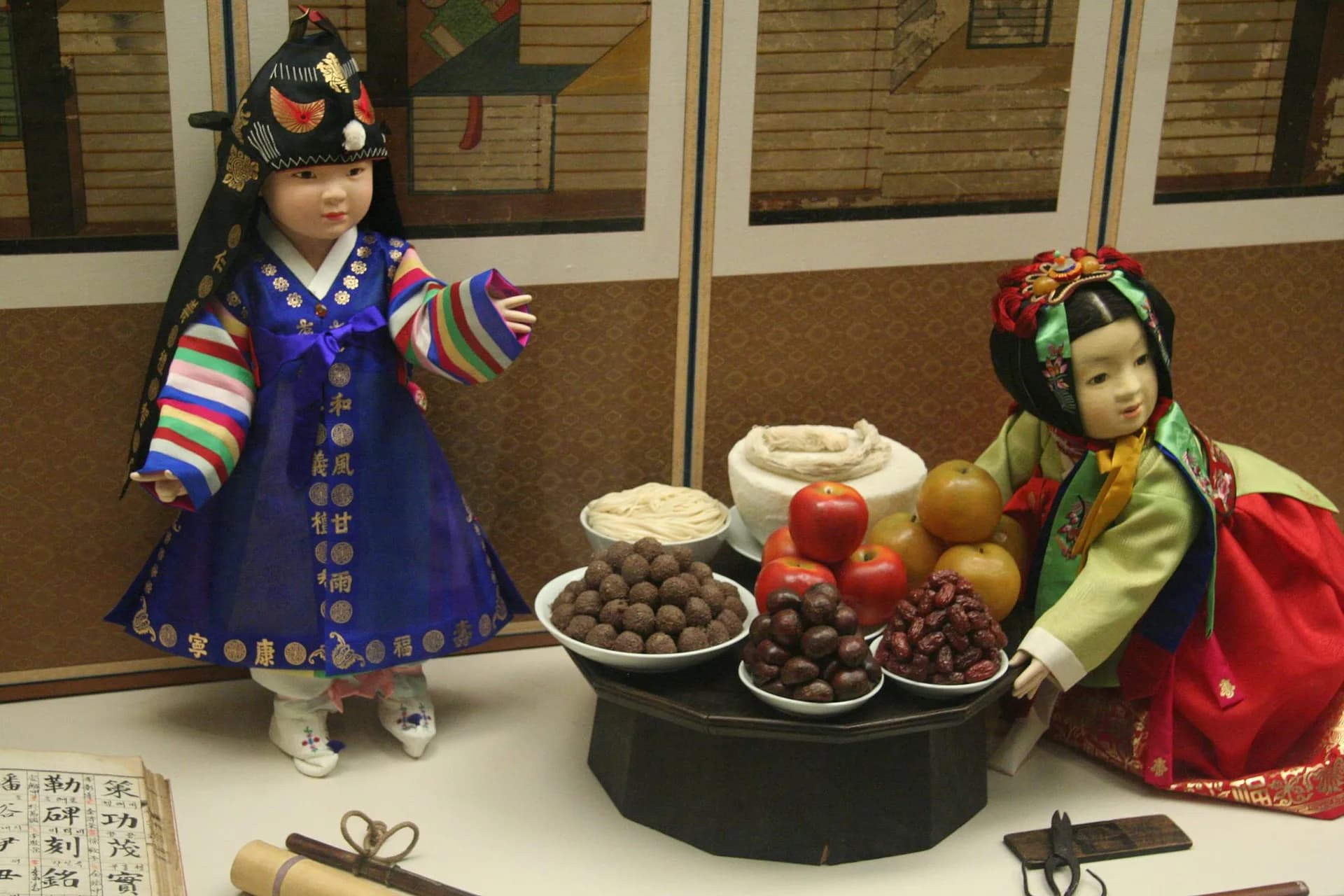
Hanbok is deeply embedded in social rituals and life-cycle events. For elite weddings, brides and princesses wore the hwarot, a richly embroidered ceremonial over-robe featuring vibrant sleeve stripes and auspicious motifs like peonies and phoenixes, symbolizing fertility and longevity. Children's clothing also carries emotional weight; young boys and girls frequently wear saekdong jeogori, which features brightly colored striped sleeves that express hopes for a joyful and prosperous life.
 Flickr : A woman wearing a jacket featuring the gorgeous-looking jogakbo · Creative Commons Attribution 2.0
This principle of material economy and aesthetic meaning extends into textile arts like jogakbo. Jogakbo is a style of patchwork wrapping cloth created by sewing leftover fabric scraps of a single material, such as silk or ramie, using a triple-stitched seam. This technique produces a flat, translucent, window-pane appearance. While historically rooted in domestic thrift and the need to minimize waste, jogakbo's geometric compositions now heavily inspire contemporary hanbok designs, interior textiles, and modern art.
A Living Language of Design
To appreciate Korean traditional clothing is to look beyond a static costume and recognize a living language of design. The meaning of hanbok emerges in motion—how the wide chima sways during a walk, or how the durumagi wraps the body against the winter wind. By observing how fibers respond to climate, how layers enforce modesty, and how modern designers continue to reinvent saekdong stripes and jogakbo patchwork, viewers can understand hanbok as a dynamic intersection of labor, ritual, and fashion.
Sources & production notes
Produced by ListenTrip